
Strategy guide
Oscar's Grind Strategy
Hold the stake after losses, nudge +1 unit after wins — grind each series to +1 unit profit.
Best for: Patient even-money sessions with small, repeating profit targets
Overview
Oscar's Grind is a classic positive-progression system first popularized for even-money wagers (red/black, odd/even, high/low). Documented by Allan Wilson and also known as Hoyle's Press or the Pluscoup progression, it divides play into short series whose only goal is +1 unit of net profit.
After a loss you repeat the same stake. After a win you normally increase the next bet by one unit — but never more than is needed to finish the series at exactly +1 unit. That cap keeps the grind from turning into an open-ended Paroli press.
Compared with Martingale it avoids exponential recovery stakes. Compared with pure Paroli it climbs more slowly and targets tiny series wins rather than multi-unit streak jackpots. Long losing stretches still burn time and chips under the house edge.
No staking rule changes probabilities. On standard European single-zero even-money bets the house edge is about 2.70% (roughly 1.35% only when French La Partage or En Prison applies); American double-zero wheels are about 5.26%.
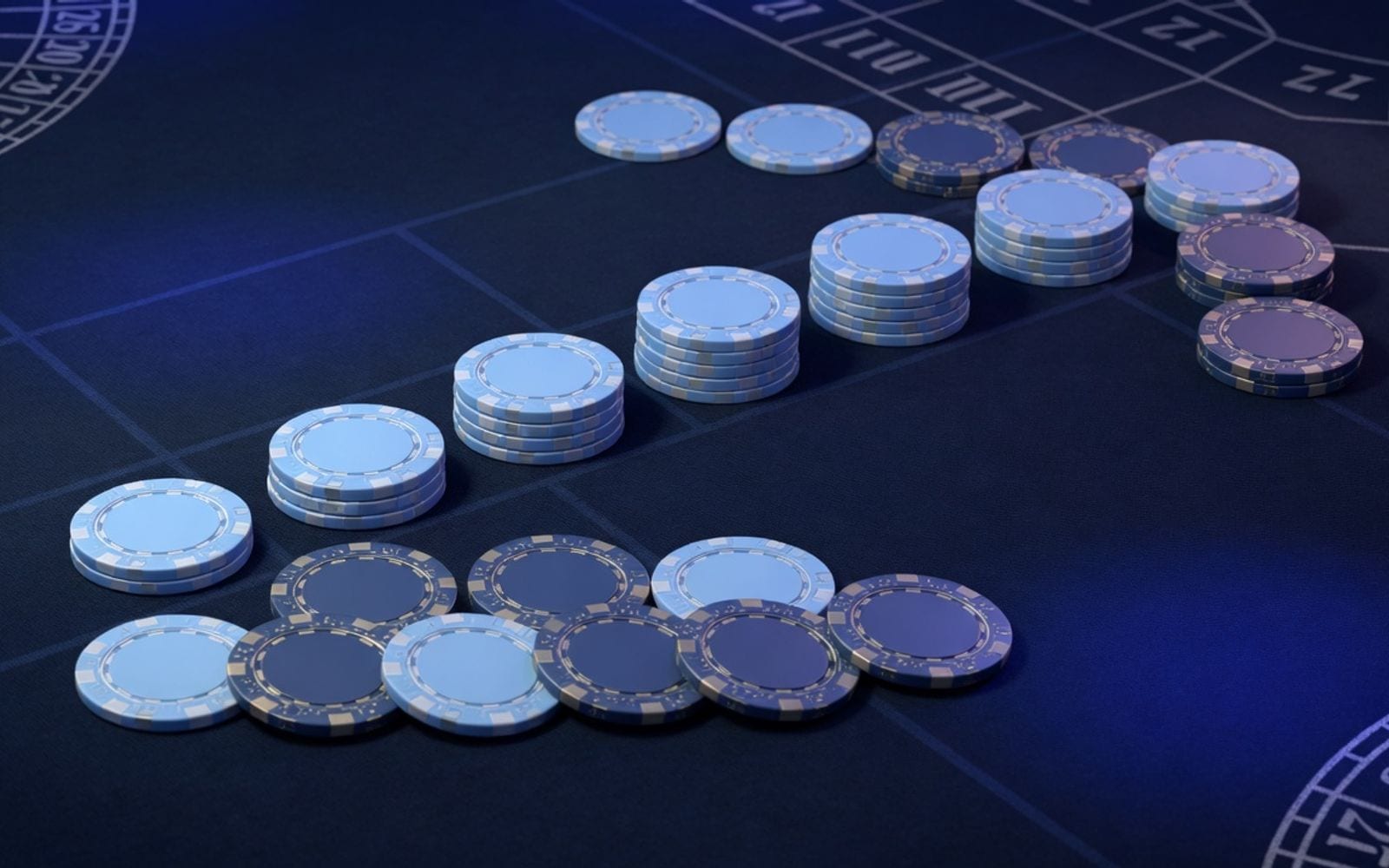
Visual progression
How it works
- Define a unit small enough for a long series (often well under 1% of session bankroll) and pick one even-money bet type.
- Start every series at 1 unit. Track series profit, not just the last spin.
- If you lose, keep the same stake for the next spin.
- If you win and series profit is still below +1 unit, increase the next bet by 1 unit — unless a smaller stake already completes the +1 unit goal; then bet only what is needed.
- When series profit reaches exactly +1 unit, end the series, bank that unit, and restart at 1 unit.
- If a win would overshoot +1 without the size cap, reduce the bet so a win lands on +1 rather than overshooting.
- Optional discipline: stop after a fixed number of completed series, a time limit, or a hard drawdown cap — never raise after losses to “finish faster.”
Series toward +1 unit (unit = $10, European red)
- Bet $10 — lose. Series −$10. Next stake stays $10.
- Bet $10 — lose. Series −$20. Stay at $10.
- Bet $10 — win. Series −$10. Raise next stake to $20.
- Bet $20 — lose. Series −$30. Stay at $20.
- Bet $20 — win. Series −$10. Raise toward $30, but only $20 is needed to hit +1 unit if it wins — size may be capped.
- Bet the amount that would bring series to +$10 on a win — win. Series +$10. Series complete; reset to $10.
Pros
- No doubling after losses — stake growth is linear and win-driven
- Clear +1 unit series target reduces open-ended over-pressing
- Well-documented rules (Wilson / Hoyle's Press / Pluscoup family)
- Easier to keep under common table maximums than Martingale
- Fits patient, low-drama even-money entertainment sessions
Cons
- A deep losing stretch can leave a series stuck for many spins
- Winning raises still increase exposure mid-series
- Tiny target profit relative to time and total money handled
- Does not overcome house edge or zero/double-zero outcomes
- Mental tracking of series profit is easy to miscount under pressure
Bankroll & table limits
- Size the unit so you can survive a long series without changing rules — many educational plans use 0.25%–1% of session bankroll per unit.
- Oscar's Grind needs depth more than peak bet size: you may place dozens of base-level bets before the series clears.
- Prefer European single-zero tables (~2.70% even-money edge) over American double-zero (~5.26%); La Partage/En Prison (~1.35% on even-money when offered) is better still for the same unit grind.
- Set a session loss limit in units (for example 20–40 units) independent of whether the current series has closed.
Common mistakes
- Raising after a loss (turning the grind into a hybrid Martingale).
- Forgetting the +1 unit cap and pressing past the series goal after a win.
- Using a unit so large that one unfinished series ends the night.
- Switching bet colors or bet types mid-series without a written reason.
FAQ
Does Oscar's Grind beat the casino?
No. It only shapes when you bet more. Over enough spins the house edge dominates expected value on every standard wheel.
Is Oscar's Grind the same as Hoyle's Press?
Yes for practical purposes — Oscar's Grind is widely treated as the same family as Hoyle's Press and the Pluscoup progression: hold after losses, step up after wins, target +1 unit per series.
What bets should I use?
Even-money outside bets (red/black, odd/even, 1–18/19–36). Inside bets break the simple unit-profit math and raise variance.
What if I am deep in the red mid-series?
The rules still only raise after wins and only enough to chase +1 unit for the series — they do not guarantee recovery. Hitting a stop-loss is correct play, not a failure of discipline.
Is it safer than Martingale?
Stake paths are usually milder than exponential doubling, so table-limit collisions are less common. Safer path ≠ positive long-term expectation.
Compare with other systems
- ParoliSimilarMedium · Beginner
Another positive progression — Paroli presses wins faster with a streak cap instead of a +1 unit grind.
- 1-3-2-6SimilarMedium · Beginner
Fixed 1-3-2-6 win ladder with automatic reset on any loss; more scripted than Oscar's series tracking.
- Flat BettingAlternativeLow · Beginner
Same stake every spin — the control group for measuring whether grinding is worth the extra tracking.
- D'AlembertOpposite approachMedium · Beginner
Negative progression: +1 unit after losses, −1 after wins — the mirror mindset to Oscar's win-driven steps.
- HollandishAlternativeMedium · Intermediate
Cycle-based negative progression in sets of three spins; slower than Martingale, different from Oscar's +1 goal.