
Player guide
How to play roulette online and offline (and still enjoy it)
Roulette is the same math on a carpeted floor and on a phone screen. What changes is tempo, distraction, and how fast you can empty a wallet. This guide is about how to walk in (or log in) as someone who is buying a good night out — not as someone trying to fix their life with a red/black streak.
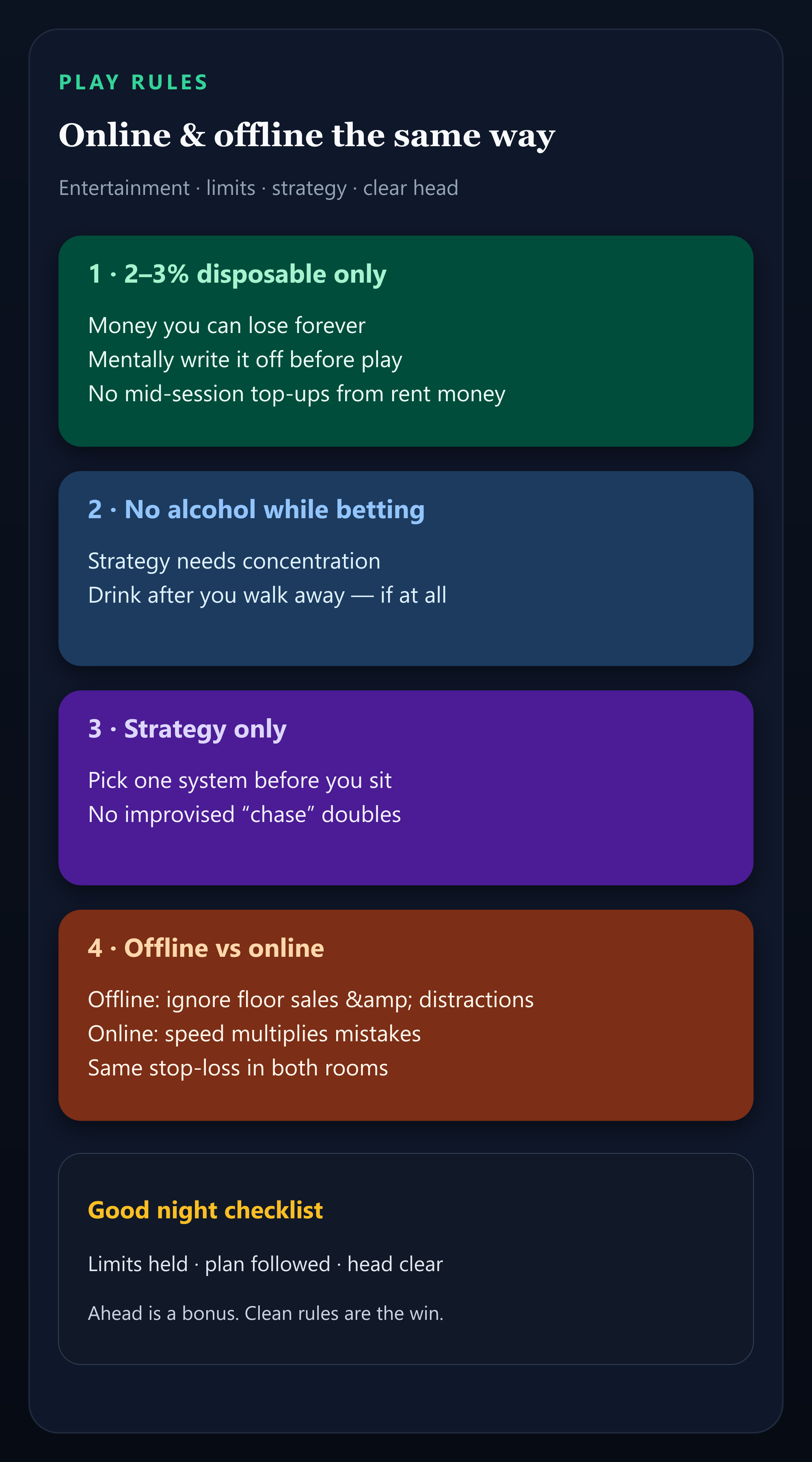
Treat the cash you bring or deposit as already spent. A practical ceiling is about 2–3% of the money you are truly ready to lose forever. That limit is the main shield against chasing losses and full-blown problem play.
Do not drink while you bet. Strategy only works if you can follow it. Online, the wheel and the rebuy button move faster, so discipline matters even more.
This is entertainment: friends, a night out, people-watching. The systems on this site give structure; they do not turn the casino into a salary.
This is entertainment, not a second income
The healthiest way to walk into a casino (or open an online lobby) is the same way you walk into a good restaurant or a concert: you already know what the evening is allowed to cost, and you came for the atmosphere as much as the result.
Bring a friend or a partner if you like company. Sit among people who flash chips like confetti. Watch how quickly “easy money” disappears when there is no plan — only hunches, doubles after losses, and another drink. That show is free education. You do not need to copy it.
We are not smarter than the wheel. We are smarter than the version of ourselves that chases, improvises, and “just one more spin.” On this site the playbook is simple: pick a strategy page, size the unit from money you already said goodbye to, and run a short session. I have played that way for more than twenty years. I never turned roulette into a job, I never became a problem gambler by design of the rules, and short sessions still finish ahead often enough to keep the game fun. When they finish behind, the bill was already paid in my head.
2–3% rule: money you have already said goodbye to
Before you leave home or before you click deposit, decide the total amount that is truly disposable for gambling in this period of your life — money you can lose forever without rent, food, or relationships taking a hit. Then bring or deposit at most about 2–3% of that figure for the night or the online session.
Why so small? Because the brain hates “temporary” losses. If the stack still feels like rent money, every red will whisper “double up and fix it.” If you have already mentally written the cash off, a bad run is annoying, not existential. That mental goodbye is the real anti-chase tool: when you top up an online balance or walk to the cage, you are not “investing.” You are buying chips for a show that might end with empty pockets.
Split that session slice into units that fit the strategy you chose. Progressions need smaller units than flat play. Write a stop-loss and a time or spin cap before the first bet. Never refill mid-session from money you had marked as untouchable.
- Disposable lifetime/period bankroll: only cash you can lose forever
- Session or deposit: about 2–3% of that disposable total
- Mental write-off: the money is gone the moment you play or deposit
- No mid-session top-ups from rent, salary, or credit
No alcohol while you play
Alcohol and roulette are a classic pair on movies and in VIP rooms. They are a bad pair for anyone who claims to have a strategy. You lose concentration, you forget why the unit size was small, and the night becomes a blur you cannot even enjoy as a memory.
Strategy means following the plan when it is boring and when it is painful. That requires a clear head. Drink after you cash out and walk away if you want a glass. During the session, water or coffee is enough.
Play only by strategy if you want a good time
“Good time” at the table is not the same as “I feel lucky.” A session goes well when you are still within your limits, you are still following the written rule, dealers rotate and the room keeps moving, and you are not inventing bets because someone at the rail got hot.
If you came to gamble without a plan, you will invent one after three losses. That improvised plan is almost always “raise until it comes back.” The strategy library on this site exists so you never need that invention. Pick one system, paper it if you are new, then run it with the unit and stop you set in advance.
- Choose one strategy page before you sit or open the app
- Write unit, stop-loss, and time/spin cap
- No mid-session switch to “whatever feels due”
- Short sessions beat all-night marathons for clarity
Offline casinos: charm, distractions, and the “friendly” table move
A live casino is theatre. Music, free drinks (which you will decline while playing), people who want to talk, hosts who want you comfortable. Comfort is fine. Losing focus is not. Ignore the soft sell of attention that has nothing to do with your chips: conversation that pulls you off the layout, “lucky” tips from strangers, and the urge to match the table’s loudest better.
Here is a myth players love: if you are winning, the night is “meant to be,” dealers change, and a floor manager smiles and offers a better table so you can enjoy yourself more. Cute story. The business side is simpler. Casinos watch play. They prefer action that lasts and bankrolls that recycle. An offer to move, to try another game, or to “make the evening more fun” is hospitality mixed with commercial interest. You do not owe them a emptied wallet for the compliment. Smile, stay on your strategy, and leave when your stop hits — profit or loss.
That does not make every staff member a villain. It means you remember who pays for the chandeliers: players who stay too long without a plan. Be the guest who had a sharp evening and left on their own terms.
Online casinos: speed multiplies every mistake
Online and live-dealer roulette remove the walk to the cage and the social brake of other people watching your stack. Auto-spin, one-click rebet, and instant deposits compress hours of offline variance into minutes. That is why strategy discipline matters more online, not less.
Set deposit limits in the cashier if the site offers them. Turn off auto-spin when you are learning a system. Use the same 2–3% disposable rule for the balance you load. If the plan is flat even-money for 40 spins, do not “just try” a Martingale mid-stream because the UI makes doubling easy.
When the session stop hits, close the tab. The lobby will always have another promo. Your rulebook does not care.
- Same bankroll write-off as offline, applied to each deposit
- Disable auto-spin while you run a structured system
- No “quick double” outside the written progression
- Prefer single-zero / European rules when the lobby allows
How to know the evening actually went well
A good night is not only “I left up.” A good night is: you stayed inside the 2–3% disposable slice, you did not drink through the session, you followed the strategy instead of the table’s mood, and you can remember the evening clearly. Finishing ahead in a short session is a nice bonus and it happens. Finishing behind with the plan intact is still a clean result — you bought entertainment at a price you accepted in advance.
A bad night is the one where you rewrite the plan after losses, top up from money that was not disposable, or stay because someone in a suit suggested “one more table.” That is how people who never meant to become problem gamblers still slide into chasing.
If you want structure that has been pressure-tested over years of real play, use the strategy pages on this site. Start with bankroll and odds guides if you are new, then pick one system and run short sessions only. That is the whole method.
Common questions
How much should I bring or deposit for roulette?
Only money you can lose forever. A practical session or deposit size is about 2–3% of that disposable total — and you should treat it as already spent before the first spin.
Is it better to play roulette online or offline?
Math is similar if the wheel rules match. Offline adds social pace and distractions; online adds speed and easy rebuys. Strategy and bankroll rules matter in both, and more when clicks are faster.
Why avoid alcohol at the table?
Alcohol cuts concentration and memory. A strategy only works if you can follow it after a cold streak, not only when you feel lucky.
Do strategies on this site guarantee profit?
No. They structure entertainment and risk. House edge remains. Short sessions can finish ahead; long-run expectation on fair casino wheels stays negative.
Continue reading
Next: all guides or strategy index.