

Player guide
Roulette betting systems, explained clearly
A betting system is a rulebook for stakes or layouts. Progressive systems react to wins and losses. Coverage systems place a fixed multi-bet package. Neither rewrites the wheel.
Public systems fall into a few families: negative progressions (raise after losses), positive progressions (raise after wins), cancellation lists, and static coverage patterns.
Use this hub to understand the map, then open each full strategy page for step-by-step examples, pros/cons, FAQs, and infographics.
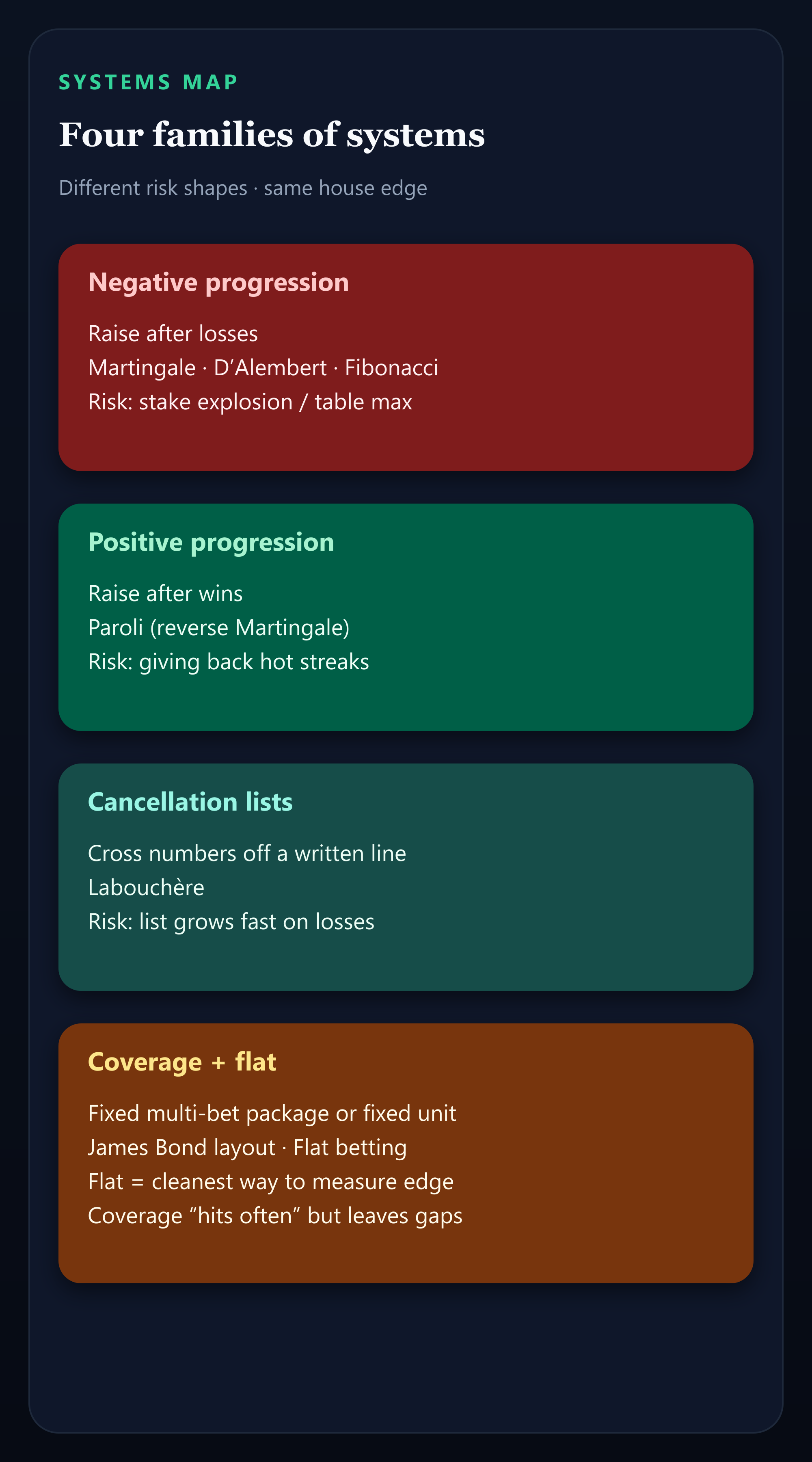
Negative progressions (raise after losses)
Martingale doubles after each loss on even-money bets, then resets after a win. Grand Martingale doubles and adds a unit — larger targets, faster limits. Both chase recovery until a long streak or table max creates a large loss.
D’Alembert raises one unit after a loss and lowers one after a win. Fibonacci walks 1-1-2-3-5-8… after losses. Hollandish raises only after full three-spin cycles. All are milder or structured alternatives to pure doubling — still negative EV.
- Martingale · Grand Martingale
- D’Alembert · Fibonacci · Hollandish
Positive progressions (raise after wins)
Paroli presses winners and resets after a loss or streak cap. Oscar’s Grind holds after losses and nudges +1 after wins toward a one-unit series profit. 1-3-2-6 uses a fixed ladder. Parlay rides the chip pile. Reverse D’Alembert and Guetting climb on success with different bookkeeping.
Tier et Tout splits a session bankroll aggressively — high drama, high ruin risk. Positive systems cap some downside per spin but still face the house edge on every dollar wagered.
- Paroli · Parlay · 1-3-2-6
- Oscar’s Grind · Reverse D’Alembert · Guetting · Tier et Tout
Cancellation systems
Labouchère starts with a list that sums to a profit target; bet first + last; wins cross off; losses append. Reverse Labouchère flips the bookkeeping to grow on wins instead. Flexible targets, heavy tracking, stake spikes when the list lengthens.
Coverage layouts & French calls
James Bond-style packages, Romanovsky (~32 numbers), Kavouras (~20-number mixed layout), and 666 / Devil’s Wheel near-full coverage all trade frequent small nets for occasional full-package losses on open numbers.
Voisins du Zéro is a classic French call covering neighbors of zero (17 numbers). Double-street systems bet six-line slices, sometimes with homebrew progressions and nicknames. Coverage is not a progression — it is geometry plus cost.
- James Bond · Romanovsky · Kavouras · 666
- Voisins du Zéro · Double street / six-line variants
Pattern & sector play
Andrucci samples spins then attacks “hot” straight-up numbers. Shotwell uses a fixed sector number map. On a fair wheel, independence makes hot/cold storytelling mostly noise — these pages explain the method and the math skepticism.
Flat betting as the control group
Flat betting keeps the stake constant. It is the cleanest way to see edge and variance. Every other system should be compared against a flat log with the same base unit and spin count.
Common questions
Do roulette betting systems work?
As entertainment frameworks, yes. As long-run profit engines on standard casino wheels, no — house edge remains.
Which system is safest?
Flat betting and mild Paroli usually create smaller drawdowns than deep Martingale. “Safer” still means negative expectation.
Continue reading
Next: all guides or strategy index.