

Player guide
How to win at roulette without the myths
Most “how to win” articles sell a progression. This one starts with the wheel, then bankroll, then systems — so short winning sessions make sense and long-run losses do not surprise you.
You can leave a table ahead. That happens often in short samples. Beating a fair casino wheel over thousands of spins with a public betting system alone is not a realistic plan — the zero(s) keep a permanent edge.
What you can control: which wheel you play, how large your unit is, when you stop, and whether you use a progression that can explode. That is the difference between entertainment and a bad night.
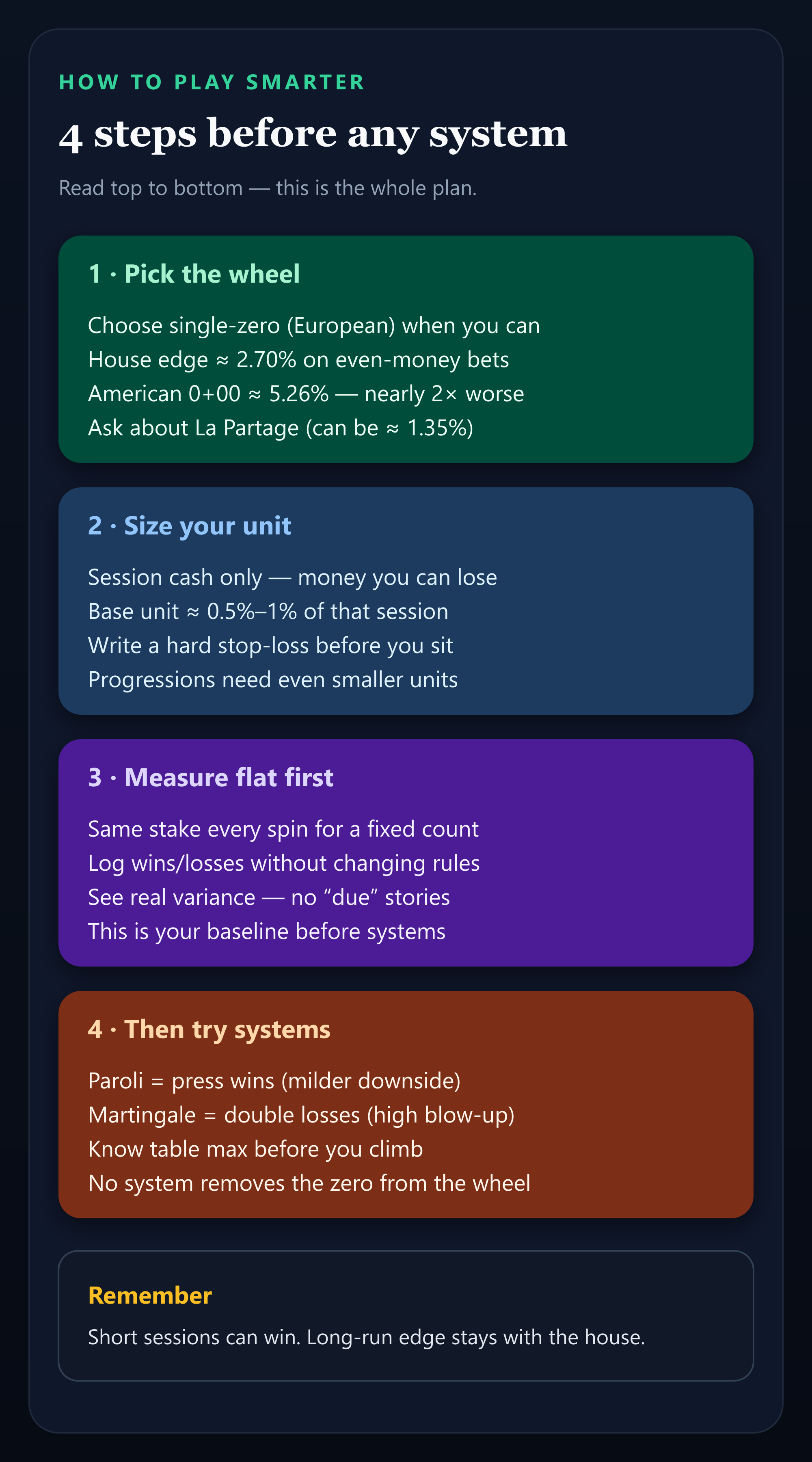
Below is the process serious players use when they study the game: lower edge first, flat measurement second, systems third — with eyes open about variance.
What winning actually means at the table
A “win” can mean finishing a two-hour session up $80. It can also mean lasting 200 spins on outside bets without busting. Neither contradicts the house edge. Casinos are built on many players having those good nights while the average result drifts negative.
The dangerous definition is “I will keep playing until I recover.” That is how Martingale-style stakes and emotional chasing meet table limits. Decide success before chips hit the felt: a loss limit, a time limit, and optionally a walk-away profit number.
The edge you are fighting (and how to lower it)
On a standard European single-zero wheel (0–36, 37 pockets), even-money bets such as red/black pay 1:1 but win with probability 18/37 ≈ 48.65%. The house edge is about 2.70% — for every $100 wagered long-term, expected loss is about $2.70.
American double-zero wheels add 00 (38 pockets). Even-money probability drops to 18/38 ≈ 47.37% and house edge rises to about 5.26%. Same payouts, worse true odds — nearly twice the long-run drain.
Some French-rule tables offer La Partage or En Prison on even-money bets when zero hits. Those rules can cut the effective even-money edge roughly in half (about 1.35%). Always read the specific table; “European layout” does not automatically mean La Partage.
- Prefer single-zero over double-zero when both are available
- Ask about La Partage / En Prison on even-money bets
- Avoid novelty triple-zero wheels (edge near 7.7%)
- Outside bets last longer; inside bets hit harder and rarer
Bankroll rules that matter more than systems
Use only money you can afford to lose completely. Split a night’s budget into a session bankroll, then pick a base unit — many educational guides suggest about 0.5%–1% of session bankroll per flat even-money unit. Progressions need far smaller base units because stakes multiply.
Write a stop-loss before you sit. Optional stop-win locks a fun profit but is not an “edge.” Either way, pre-commitment beats mid-session emotion.
If you plan Martingale or Fibonacci, calculate stake depth N and confirm it still fits under the table maximum and your cash. If the tenth double exceeds the max, the system is incomplete.
Where betting systems fit (and where they fail)
Progressions change the shape of wins and losses. Martingale aims for frequent small recoveries until a long losing streak or table max creates a large loss. Paroli presses winners and usually caps downside near one unit. D’Alembert and Fibonacci climb more slowly. Labouchère uses a cancellation list. James Bond-style layouts are fixed multi-bet packages, not progressions.
None of these change pocket probabilities. Use them only after you understand odds and bankroll. For learning, log flat bets first so you have a baseline free of progression noise.
- Learning baseline: flat even-money on a single-zero wheel
- Milder progression: Paroli with a 3-win stop
- Highest blow-up risk: deep Martingale
- Most bookkeeping: Labouchère and Fibonacci
A practical playbook for better sessions
1) Choose the lowest-edge rules you can find. 2) Set unit, loss limit, and time/spin cap. 3) Prefer outside bets if longevity matters. 4) Avoid chasing with improvised doubles. 5) Take breaks; fatigue creates “one more spin” mistakes. 6) After the session, log results honestly — not just the highlight reel.
If you want structured systems next, open the strategy index and compare risk labels before you risk real money.
Common questions
Can any strategy guarantee roulette wins?
No legitimate guide should claim a guarantee on standard casino wheels. Progressions reshape variance; they do not invert house edge.
What should beginners study first?
Wheel differences (European vs American), even-money odds, bankroll limits, and a flat-betting log — then systems like Martingale or Paroli with open eyes about risk.
Is European roulette enough to “win”?
It lowers the edge versus American tables, which helps your bankroll last longer. It still leaves a negative long-run expectation.
Continue reading
Next: all guides or strategy index.