

Player guide
Roulette bankroll management that actually helps
Systems fail less often from “bad luck” than from units that are too large for the plan. Bankroll rules are the strategy underneath every strategy.
A bankroll is not your entire savings — it is the money dedicated to play that you can lose without damage. Split it into sessions, then into units.
Progressions demand smaller base units than flat betting because one losing streak multiplies exposure. Table maximums can freeze a Martingale mid-climb.
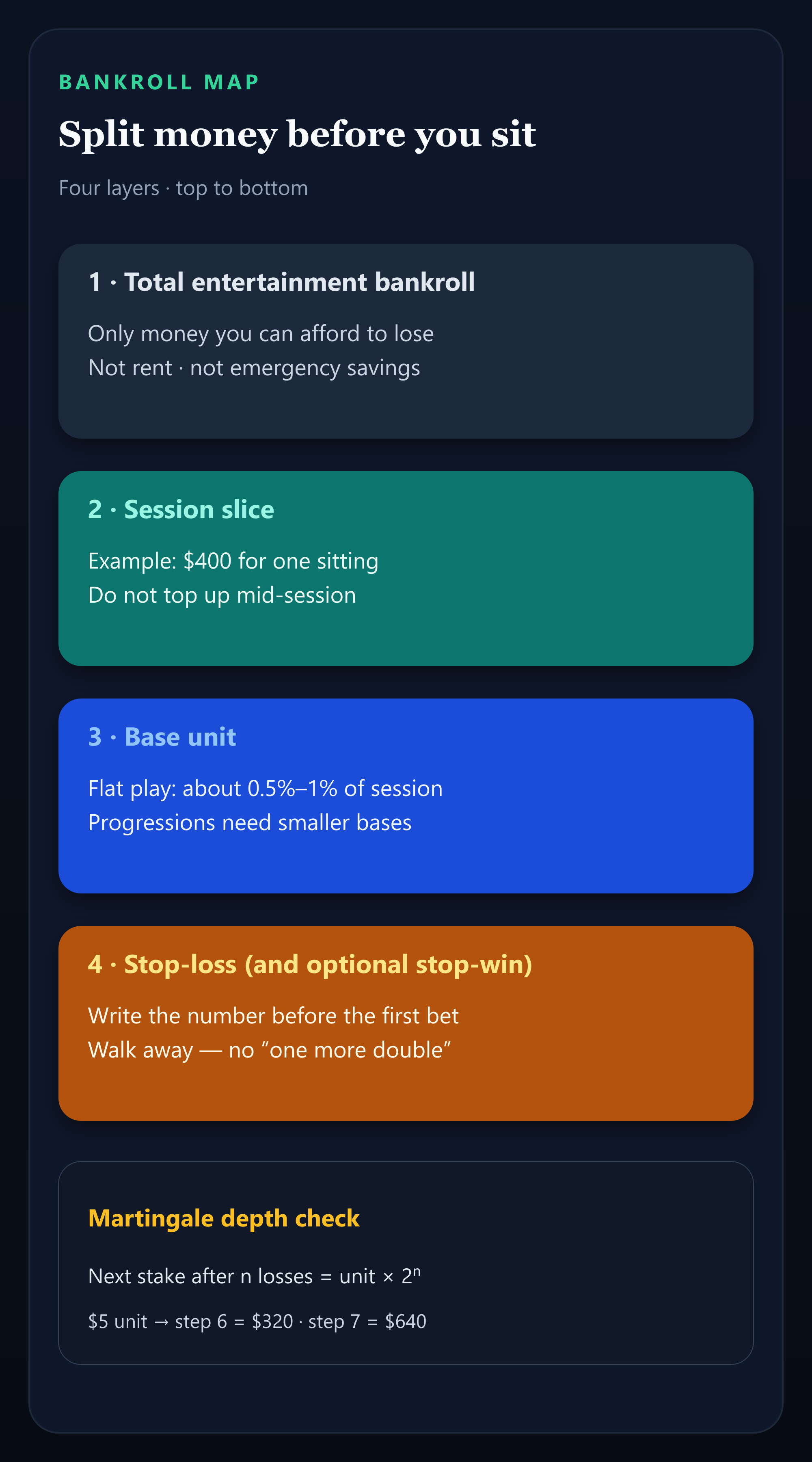
Define bankroll, session, and unit
Bankroll: total entertainment capital for roulette over a period (night, weekend, month). Session bankroll: the slice you bring to one sitting. Unit: the base chip size for your plan.
Educational starting ranges for flat even-money play often sit around 0.5%–2% of session bankroll per unit. Pick the lower end if you want more spins; pick higher only if you accept faster variance.
Stop-loss, stop-win, and time caps
Stop-loss: the amount that ends the session no matter how “due” the next spin feels. Stop-win: optional lock on profit. Time or spin caps: prevent fatigue-driven mistakes.
Write these numbers before the first bet. Mid-session negotiation is where bankrolls die.
- Example session: $400 bankroll, $4 unit (1%), $120 stop-loss (30%)
- Example progression: $1 unit only if depth-8 stake still fits cash and table max
- Never top up a session from untouchable funds
Bankroll math for progressions
Martingale depth: after n losses the next stake is base × 2ⁿ. Sum of a full losing run to that point is base × (2ⁿ⁺¹ − 1) before the winning spin. If table max is $500 and base is $5, you cannot complete many doubles.
Fibonacci and Labouchère climb differently but still require a pre-computed ceiling. If you cannot state the worst-case stake you will allow, you do not have a complete system.
Habits that protect cash
Prefer single-zero tables. Avoid alcohol-fueled unit increases. Log results after, not during emotional peaks. Take breaks every fixed number of spins. Treat “borrow from next month’s budget” as a session-ending red flag.
Common questions
How big should my roulette bankroll be?
Only use money you can afford to lose entirely. Progression testing needs more depth than flat unit play for the same base bet.
What unit size is safe?
There is no safe unit against house edge. Smaller units relative to bankroll simply let you play longer and reduce the chance of a single bad sequence ending the night.
Continue reading
Next: all guides or strategy index.